Mostrando entradas con la etiqueta Privat-Livemont. Mostrar todas las entradas

domingo, 5 de febrero de 2017

Geometry in Glass

Geometry in Glass


Not all Art Nouveau consists of sinuous curves and writhing plants. Some builders as Paul Hankar, Paul Hamesse or Paul Cauchie, influenced by different European currents as the Sezessionsstil of Vienna or the Scottish School with Charles R. Mackintosh, preferred simple geometric lines as circles or triangles. The glass artists generally adapted to the style of the construction, always with the idea of total art in mind.


Ecole Nr.1, Rue Josaphat 229 and Rue de la Ruche

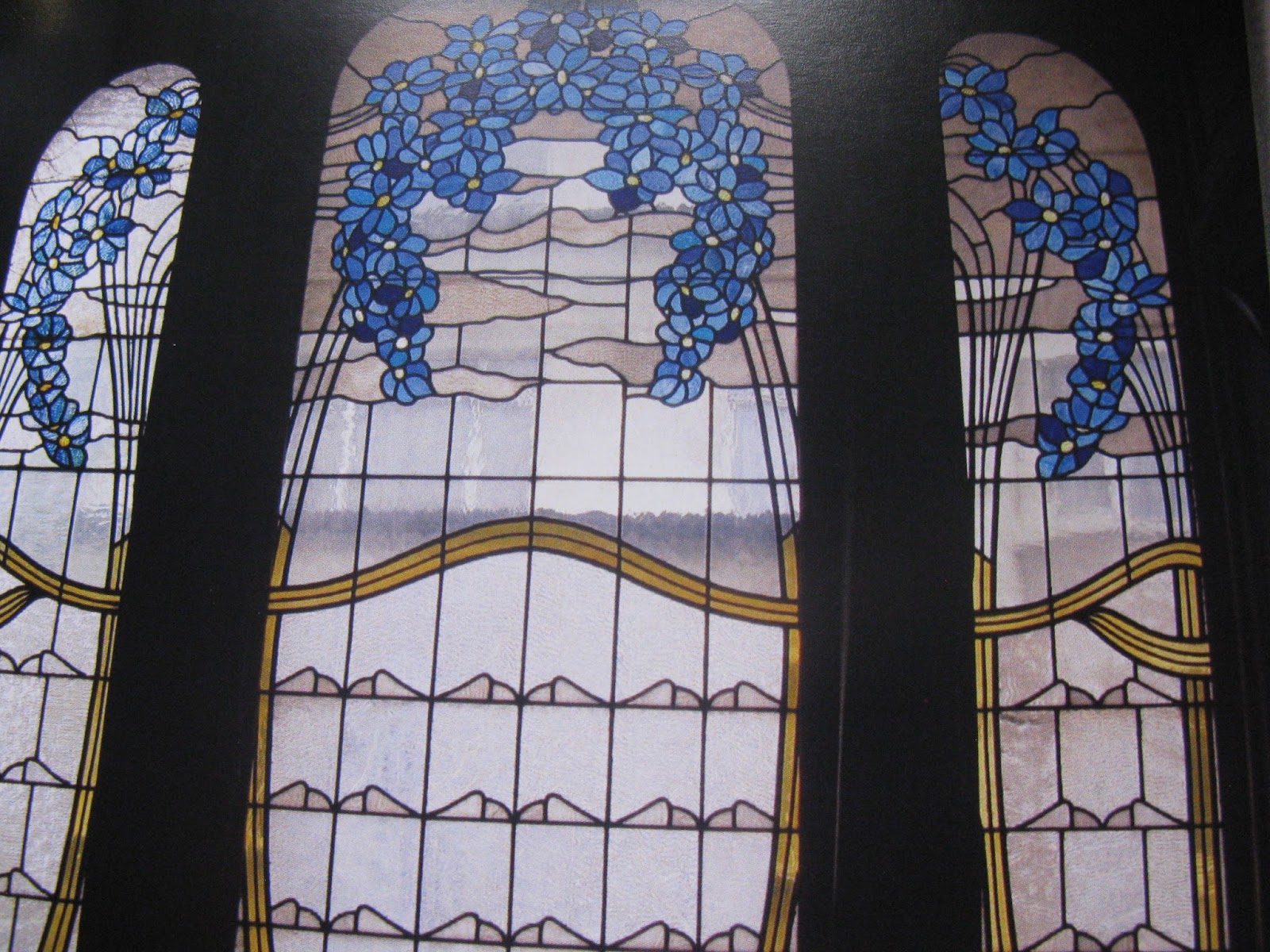
Henri Jabobs built this public school in 1907 on a double plot accessible from both streets. Here the architect put into practice his revolutionary ideas of improving education by the influence of art. For this purpose he devised a huge central  playground covered with a metallic structure and decorated with marvelous sgrafitti designed by Privat-Livemont, one of the most famous designers of the period. Entering the building from the back side (Rue de la Ruche) we find our object of stained glass, a long corridor opening to the courtyard but protected by a flight of huge stained glass windows. Yellow and white glass filter a pleasant light through its translucent glass. Simple rectangular pieces of glass dominate the big central part of the windows. Only by looking at its lower and upper extremes it becomes evident that the geometric central design represent the long stems of highly stylized flowers.

Corridor window in Ecole Nr.1


Rue Charles Martel 52

This tiny window in stained glass in the European quarter is another representation  of the  geometric tendency in the Art Nouveau style while borrowing at the same time  elements from nature in schematic form. Three tulip-shaped patterns in dark green opalescent glass  are set against a grill  of simple squares and half-circles of translucent glass. The picture is framed by a plain yellow glass border.

Window in Rue Charles Martel 52


Hotel Cohn-Donnay in Rue Royale Ste.Marie 316

This classical building was altered and refurbished by the architect Paul Hamesse in 1904. He managed to blend in one building different tendencies of Art Nouveau, from influences of the Viennese Secession or the line of  Mackintosh, in an absolutely harmonious way.
The window at the ceiling of the billiard room is one of the most perfect examples in geometric Art Nouveau, the subject of this post. That's why I did not want to disregard this photograph in spite of its low quality. Squares and circles, half and quarter circles in yellow and white are its unique elements - but with what effect! The result is a most intricate design of highest quality.
Contrasting with this geometric design Hamesse placed right underneath this ceiling a window in the same yellow and white colors but in attractive curvy lines.


Billard room ceiling in Rue Royale Ste. Marie 316


Rue St.Quentin 30


Continuing in the European quarter we find this square window, all in blue. A double circle in dark blue glass in its upper part dominates light blue rectangles in ripple glass around. An inverted plant inside the circles is painted on the glass, possibly a later addition. Drops of turquoise opalescent glass interrupt the grid of rectangles while a row of romboid elements make up the bottom of the window. The extraordinary luminosity of stained glass windows is at its best when seen from inside the room. Unfortunately, no access was possible in this case.


Window in Rue St. Quentin 30


Charles V,  64


Geometric lines with a faint reminiscence of nature compose the design of this little window in the European quarter. A big circle encloses symmetric lines evoking the idea of a bunch of flowers. Sparkling yellow frost glass enhance  this impression. The four corners of the square window are filled each with a rising sun in yellow ripple glass. The chosen colors of this window, yellow and white on a mauve background achieve a very elegant result.


Window in Rue Charles V, 64


Chaussée de Waterloo 252

In the year 1901 the architect Van Oostveen built several houses in a row in Chaussée de Waterloo in geometric Art Nouveau style. Unfortunately, all of them are in a rather precarious condition demanding urgent restauration. All of these buildings show great originality in the design of wrought iron balconies, sgraffitti decorations (partly covered with paint!) or stained glass. The number 252 features on its upper floor a rare stained glass window stretching over the whole front of the house. Over the seven panels divided by delicate stone columns striking yellow glass rectangles evoke the rise of the sun. The artist placed contrasting blue elements above the sun forming a most singular design which reminds butterfly wings. Even if the image taken from the street is quite poor the window is worth a visit.


Seven-panel-window in Chaussée de Waterloo 252


Rue Eburons 54

An eclectic and otherwise unobtrusive building  in red and white brick in the European quarter holds this interesting window in two symmetric panels. With an ingenious combination of the geometric and the floral tendency of Art Nouveau the artist achieved a harmonious picture. Two opposing wings in purple color, each with an inserted flower, are set against a yellow geometric backdrop. Bright blue glass squares frame the window underlining its geometric character.


Window in Rue Eburons 54


domingo, 29 de enero de 2017

Waves, Clouds and Floating Hair in Glass

Waves, Clouds, Floating Hair....in Glass


In past chapters we have seen how the Art Nouveau artists made abundant use of the subject of nature, be it flowers, trees, butterflies or birds. In this post we will see the handling of clouds, waves or ondulating long hair in the composition of stained glass windows, some of them obtaining world wide fame.

Maison Autrique

In my post of "Flowers in Glass" we have seen already a beautiful staircase window in Horta´s Autrique house. Right above this window but directed towards the sky we find this second window in the same delicate colors ranging from white to mauve and brown. While the inferior window depicts flowers and trees the subject of this stained glass is a cloudy sky interrupted only by the flight of grouses. The flowing lines of the clouds and the soft colors like cream, mauve or brownish transmit the airiness of the composition. The choice of different glass textures - as for instance glittering ripple glass for the grouses - serves to enhance the moving birds.


Staircase window in Maison Autrique


Rue Jef Lambeaux 36


Several Art Nouveau houses built by the architect Georges Peereboom line this street. The number 36 shows this charming fanlight above its door. We contemplate here a picture of exuberant nature in most lively colors where clouds and water occupy an important place pronounced by the masterly choice of glass colors and textures. A white swan is overflying the water surface. The intense green of a group of trees made of opalescent glass is contrasting with the declining sun and its white and mauve rays. White and greyish clouds in sparkling ripple glass cross the sun rays. The mirror-like water surface at the bottom of the picture is glittering, another proof of the wise selection of glass.


Fanlight in Rue Jef Lambeaux 36


Rue de l´Arbre Benit 123


Now I present you with one of the most famous stained glass windows in all Art Nouveau. The design of this window is due to the well-known designer and painter Privat-Livemont, largely influenced by the artistic current of symbolism  as well as to the emerging interest in japonism. The glass artist Raphael Evaldre has been able to translate this extraordinary design in stained glass. Paul Saintenoy, the architect of the famous "Magasins of Old England" in the centre of Brussels commissioned these artists to finish his recently acquired house. 
A young woman with folded hands like in prayer is looking out across the sea. Foaming waves and the woman´s long floating hair are exploited to develop arabesques characteristic for the style of Art Nouveau. The inherent symbolism of waves and ondulating hair stand for the woman´s anguish. This violent movement at the bottom of the picture constrasts with the lineal calm of the clouds in the superior part of the composition. The same yuxtaposition of turbulence  and calm can be followed in the decrease of colors, from the rich palette at the bottom to the single blue tonalities in the superior part. The expert handling of glass colors and textures by master Evaldre are most evident in the waves´ sparkling quality or the soothing blue of the linear clouds. 


Living room window in Hotel Saintenoy


The staircase of Hotel Saintenoy is lighted by another stained glass window, probably a product of the same artists as of "The Wave". The subject of huge waves with their white foam is repeated in this window. They seem to come alive contrasting strongly with the static flowers at the bottom of the window. A frame in stained glass repeats the wave motif, but in regular sequences and in golden colors. 


Staircase window in Hotel Saintenoy


Rue Vogler 17


A rather unobtrusive building with only few Art Nouveau embellishments surprises with this delicious little window above the entrance. It is one of the numerous anonymous works of stained glass all over Brussels indicating the great liking it found among its people. A boat with its white opaque sails above the turquoise-colored sea is set in front of the golden rays of the sky. Again we see the use of opalescent glass for the sea underlining its prominence.


Fanlight in Rue Vogler 17


Rue Philip le Bon 55


A lovely Art Nouveau house in the European quarter, built by Armand van Waesberghe in 1902, includes in its exterior decorations beautiful sgraffiti pannels on the second floor as well as this big fanlight forming a perfect unit with the door. The water surface in light blue glass  at the bottom and the mauve-colored clouds in the upper part are held together by an ondulating plant. The whole picture  is kept in delicate pastel colors. 


Fanlight in Rue Philip le Bon 55


domingo, 15 de enero de 2017

Features of Art Nouveau

Features of Art Nouveau

For Art Nouveau lovers as myself Bruxelles is a real paradise. Each town quarter  contains lovely buildings in this attractive style from around 1900. Its architecture is already widely treated in numerous books. Therefore, the subject I want to show here in these pages is the much less known but equally fascinating stained glass works. Windows, doors or cupolas as integral part of the building provide filtered light to the dwellings, a concept so dear to Art Nouveau architects, in a highly artistic way.


Window in Hotel Hannon

         In the period around 1900 emerged a new style in European Art and Architecture, the Art Nouveau style. Leaving behind Victorian sentimentality with its constant look to the past it meant a turning point in Western Art and Architecture by exploring a progressive and adventurous way of expression. Even if the newly created style was rather short-lived its importance lies in the application of new concepts in Art as well as in Architecture all over Europe and beyond. Its significance even goes beyond its creation by paving the way for future movements as Art Deco and Modernism. Taking conscience of the beauty of nature and incorporating it into art and architecture was a basic aim of Art Nouveau artists. Appreciated motives range from flowers and trees to insects, from waves to ondulating curves. The representation of these objects does not want to be an imitation but a highly stylized form of it. The Art Nouveau Style is distinguished by its elegance, sensuality and decorative effect. Flowing curves and double curves insinuating writhing plants, undulating lines as for instance Horta’s famous whiplash curve, flames and waves or the flowing hair of female figures are most characteristic expressions applied in both the structure and the decoration of the building. Although Art Nouveau often is boldly asymmetric it achieves great harmony. 


                                                        Horta's whiplash motif


       Contrasting with this highly sensuous style we find another nearly opposing tendency in Art Nouveau - the geometric line. Paul Hankar in Belgium was a defender of this trend, strongly influenced by the Viennese and the Scottish Art Nouveau. Geometric forms as circles, semi-circles or triangles play an eminent role pointing already to the future Art Deco. This geometric austerity in iron structures or sgraffiti as decorative elements made the houses affordable for a much wider public, being the "democratization" of house building another goal of Art Nouveau architects. The Ciamberlani house in Brussels is a perfect example for this style.


Hotel Ciamberlani by P. Hankar


The new concept of “Gesamtkunstwerk” or total art wanted to create a fusion between structure and ornament. Thus columns or beams became thick vines with spreading tendrils like that of a living organism, leaving behind previous efforts of hiding structural elements. Either in curvy stone work, in swirling iron balconies, in thematic sgraffiti or in stained glass windows, the architect sought the greatest possible harmony among the different elements. In order to obtain this goal of total art the Art Nouveau architect not only designed the building but every single element in it such as floor mosaics, stair landings, door handles and even furniture. 


Iron balcony by V. Horta


        One of the major assets of Art Nouveau construction is the use of natural light in planning a building with the intention of bathing its interiors in light, adding quality of life to its inhabitants. The use of stained glass panels fitted perfectly into the concept of a well lit dwelling. The typical long but narrow building plot of Brussels often became a site of experiment with innovative sources of light, as a glassed dome in the central section or stained glass doors for the otherwise central dark room. Stained glass windows looking out to the street, particularly on the ground floor, often shelter the inhabitants from outside-viewers while filtering soft light to the inside. 
In the next post I will enter fully the subject of stained glass with the presentation of some works with one of the dearest motifs to Art Nouveau architects and artists: flowers and plants.